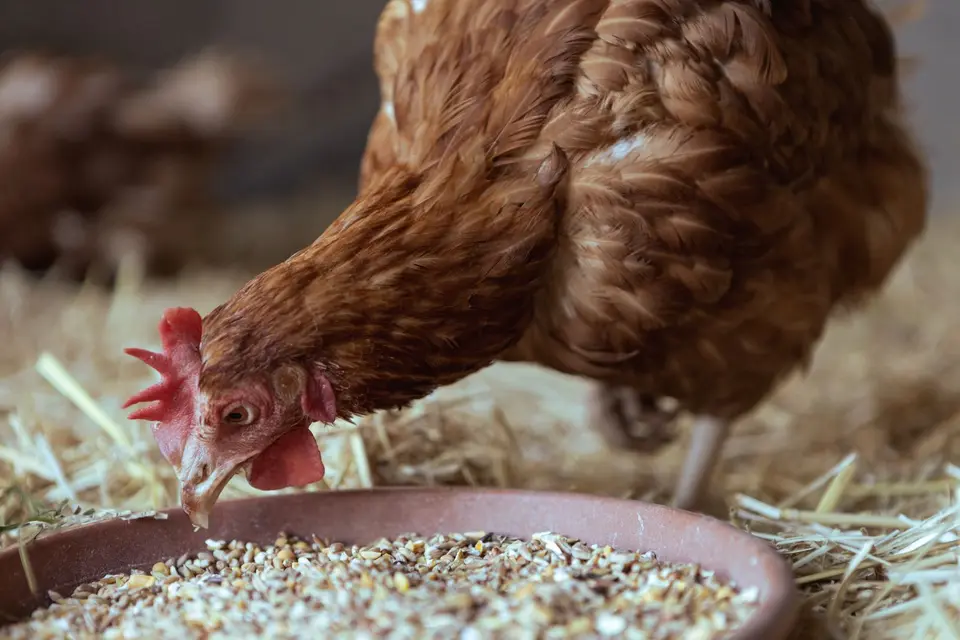
On a certified organic farm, laying hens are fed organic feed. The grains and other plant ingredients in it must come from organic production, and the standard limits which additives can be used. Antibiotics, anticoccidial drugs and growth promoters may not be put in feed to speed growth or raise output. This article describes the rules in general, using the Thai organic standard.
A note on the documents. Thailand's organic standard TAS 9000-2021 puts the general rules in one text and says its annex on livestock will be published later. The livestock details below come from the earlier livestock part, TAS 9000 Part 2-2018, as reproduced in a Department of Livestock Development manual. The general rules come from the 2021 text.
The feed rule
The 2021 standard states the principle: livestock are fed organic feed made of agricultural ingredients from organic production, plus natural substances that are not of agricultural origin. Organic products from livestock come from animals raised organically from birth or hatching. Organic production also excludes genetically modified organisms in feed.
The livestock part sets percentages, counted on dry weight:
- At the start of conversion, feed for single-stomach animals must be at least 65 percent organic ingredients.
- If a farm cannot source fully organic feed, the minimum is 80 percent for single-stomach animals, calculated over the year's feed needs, and the certification body must agree first.
- Any non-organic part must be natural plant, animal or mineral material. Non-organic plant ingredients must not have been through chemical processing.
- Chicks may be given ordinary chick feed for up to 4 weeks after hatching if it contains no genetically modified material and no synthetic substances.
A feed product that is itself labelled organic needs at least 95 percent of its dry weight from organic production.
What may not be added
The livestock part bans antibiotics, anticoccidial drugs, modern medicines, growth promoters and any other substance in feed for the purpose of speeding growth or raising yield. It also bans non-protein nitrogen and synthetic nitrogen compounds. Vitamins and minerals must be natural in origin. Synthetic ones are allowed only in a shortage or in force majeure, with the source and process documented. Binders, preservatives, flavours, colours and appetite stimulants must come from natural sources. Probiotics and enzymes are allowed if they are not genetically modified or synthetic.
In the EU, a 2024 paper in Frontiers in Animal Science notes that synthetic amino acids are prohibited in organic feed. The authors say this makes it hard to balance a diet when organic protein sources are limited.
What hens are given besides feed
The Thai standard asks that poultry have fresh, dry or ensiled roughage every day, and that clean water is always available. Its principles also say that animal by-products should be avoided as feed.
For typical ingredients, Oregon State University Extension describes ordinary layer feed as common grains such as corn, barley or wheat, soybean or canola meal for protein, limestone, oil or fat, and a vitamin and mineral premix. It adds that laying hens need extra calcium, 3 to 4 percent in the feed, for shell formation. The same source defines organic feed as ingredients from organic sources, grown without commercial fertilisers or pesticides, from non-GM seed, and without medications or synthetic nutrients. In an organic ration, each of these ingredients must meet the organic rules.
Medicine, conversion and records
The standard prohibits antibiotics for disease prevention. A sick or injured animal must still be treated at once, even if treatment ends its organic status. Herbs, natural minerals or alternative medicine come first. If they fail, modern medicines or antibiotics may be used under a veterinarian, with a withdrawal period twice the one on the label. The standard also limits how many courses of such treatment an animal may have in a year. Beyond that limit its products cannot be sold as organic and the animal must go through conversion again. Every treatment is recorded with the drug, how it was used and the withdrawal period.
For egg production, the livestock part sets a conversion period of 6 weeks. The 2021 standard requires organic records to be kept for at least 5 years.
In short
- Organic hens are fed organic-grown ingredients, with a minimum organic share counted on dry weight.
- Antibiotics, anticoccidials and growth promoters may not be used in feed to speed growth or raise output.
- Synthetic additives are tightly limited, and additives such as colours and flavours must be natural.
- Hens also get roughage and clean water, and sick animals are treated with records and doubled withdrawal periods.
- The rules above belong to the Thai standard unless the EU is named.
Sources
- Department of Livestock Development manual 2024, reproducing TAS 9000 Part 2-2018, Organic Livestock (Thai)
- Thai Agricultural Standard TAS 9000-2021, Organic Agriculture (unofficial English translation, ACFS)
- Oregon State University Extension, How to feed your laying hens
- Göransson and Lundmark Hedman (2024), The perks of being an organic chicken, Frontiers in Animal Science