Milk is organic when the cows, their feed and the land behind them follow a written organic standard, and an inspection checks it. The rules cover feed, access to pasture, how long animals must be in conversion, and how sick animals may be treated. They differ by country, so this article says which country each rule belongs to.
In Thailand, the general standard TAS 9000-2021 brings earlier separate organic standards into one document, but the text says its annex on livestock was to be announced later. The livestock details below therefore come from the earlier standard for organic livestock, TAS 9000 Part 2 of 2011, issued by the National Bureau of Agricultural Commodity and Food Standards (ACFS).
Feed and grazing
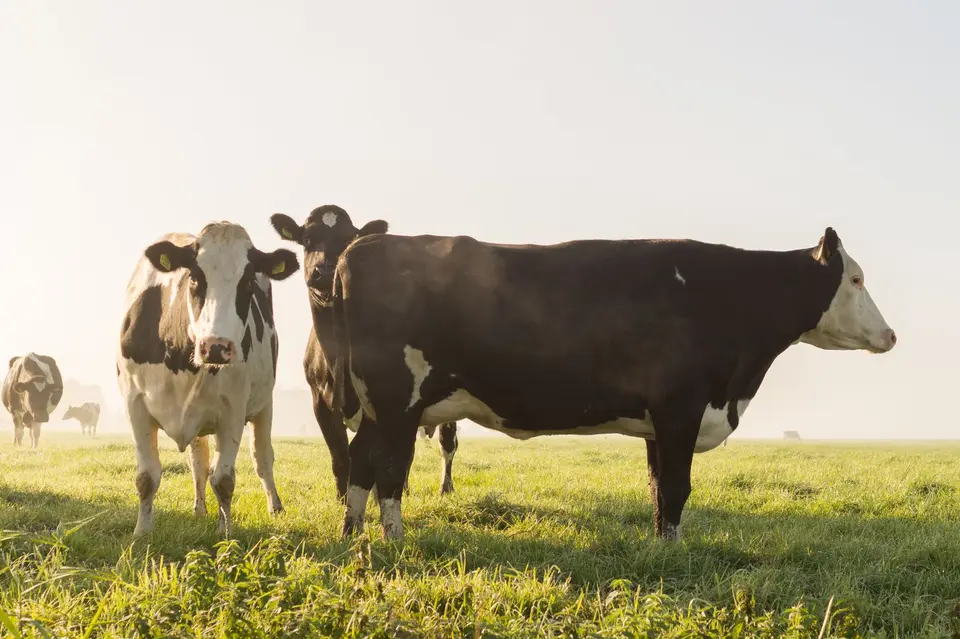
Thailand. Feed should come from organic farming. When a farm starts converting, at least 70 percent of the dry matter in feed for ruminants such as cattle must be organic. If a farm cannot supply all organic feed, the standard allows at least 90 percent for ruminants, with the certifier's approval. Any non-organic part has to come from natural plant, animal or mineral sources. Plant eaters must have grazing plots, with some exceptions such as bad weather or the final stage of gestation. Roughage, meaning fresh, dried or ensiled forage, must make up at least 60 percent of daily dry matter, though it may be set by season or stage of lactation as long as it stays at 50 percent or above. Ruminants must not be fed silage alone. Antibiotics, anticoccidial drugs and growth-promoting substances are banned in feed when used to speed growth or raise output.
United States. Under the federal organic rules, 7 CFR part 205, feed must be organic. Ruminants must graze for at least 120 days in a calendar year. In the grazing season, pasture must supply at least 30 percent of dry matter intake on average, and the dry feed given is limited to an average of 70 percent of what the animal needs. Growth-promoting drugs and hormones are banned, as are antibiotics in feed.
European Union. The European Commission states that animals should have access to open air or grazing whenever possible, and that farmers must give 100 percent organic feed, ideally from the farm or the same region.
Conversion
Land and animals both need time to convert.
Thailand. Land used for feed crops needs 12 months of conversion for annual plants and 18 months for perennial plants. For milk, cattle, goats and sheep need a 90-day conversion. After that the milk may be called organic in conversion. A further 6 months must pass before it can be certified as organic milk.
United States. Dairy animals must be under continuous organic management for at least 12 months immediately before the milk is sold as organic. A farm that has never converted dairy animals may convert non-organic animals only once.
The EU conversion periods for milk were not checked for this article, so none are given.
Veterinary drugs
Thailand. A sick or injured animal must be treated at once, even if that ends its organic status. Herbs, natural minerals or alternative medicine are tried first. If they fail, drugs or antibiotics may be used under a vet, with a withdrawal period twice as long as the label states, or at least 48 hours where the label gives none. Antibiotics may not be given routinely as a precaution. An animal treated with drugs or antibiotics more than twice in a year, or once if under a year old, may not be sold as organic and goes back into conversion. Hormone treatment must be supervised by a vet.
United States. An animal treated with antibiotics cannot be sold as organic. Drugs may not be given in the absence of illness, except vaccines. Growth hormones are banned. Producers must not withhold treatment from a sick animal to protect its organic status.
European Union. The Commission says antibiotics and other veterinary medicines may be used when animals are ill, under strict conditions. Hormones are not permitted except as treatment for an individual animal, and growth promoters are forbidden.
In short
- Organic milk is defined by a written standard and inspection, not by the look of the milk.
- Thailand, the United States and the European Union all require organic feed and ban growth promoters.
- Thai rules ask for roughage to be at least 60 percent of daily dry matter, adjustable by season or stage of lactation but never below 50 percent.
- The US sets a numerical grazing rule: at least 120 days a year and 30 percent of dry matter intake from pasture.
- A cow treated with antibiotics cannot supply organic milk in the US, and in Thailand more than two treatments with drugs or antibiotics in a year send her back into conversion.