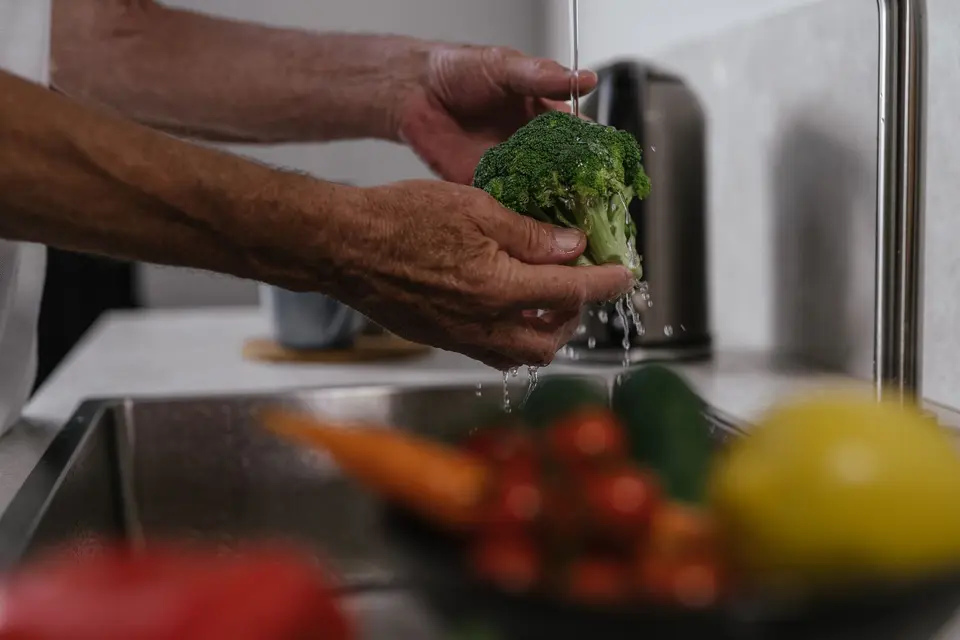
Rinse vegetables under running water, rub the leaves gently, and do it close to the time you cook or eat them. Thai FDA describes three soaking methods, all finished with a rinse in clean water. It also says plainly that washing cannot remove everything, so washing is one step among several rather than a guarantee.
What Thai FDA describes
Thai FDA published an infographic in February 2024 with three ways to wash vegetables. Each method is aimed at pesticide residues and at germs on the surface.
- Running water. Soak the vegetables for 15 minutes, then hold them under running water and rub the separated leaves for 2 minutes. Thai FDA says this suits small amounts and lowers residues by 54 to 64 percent.
- Vinegar. Mix 1 tablespoon of 5 percent vinegar into 4 litres of water, soak for 15 minutes, then rinse with clean water. The stated reduction is 29 to 38 percent.
- Baking soda. Mix half a tablespoon of sodium bicarbonate into 10 litres of water, soak for 15 minutes, then rinse with clean water. The stated reduction is 80 to 95 percent.
The infographic credits these percentages to a university medical centre nutrition unit. They describe how much pesticide residue was reduced in testing, and the ranges are wide. They do not tell you how clean one particular bunch has become.
Thai FDA adds that washing cannot remove residues completely. Its tips for choosing vegetables include natural colour, no white film that looks like chemical residue, no unusual smell, and eating vegetables in season.
Dirt, germs and parasites
Residues are only part of the picture. The Thai FDA page says washing also helps against disease-causing microbes on the surface.
The Department of Medical Sciences tested this in 2013 and 2014. It collected eight kinds of vegetables that people often eat raw from fresh markets in Bangkok and nearby provinces, ten samples of each: peppermint, lettuce, spring onion, gotu kola, Chinese chives, celery, coriander and parsley. Unwashed, all eight kinds contained worm-type parasites, and seven kinds also had roundworm eggs.
Washing reduced the counts. The three methods tested were a plain water soak, a soak in 15 mL of 5 percent vinegar per 4 litres of water, and a soak in 15 g of salt per 4 litres of water, each followed by a rinse. The researchers found no significant difference between the three, so in this test the choice of method made no clear difference.
Habits from United States guidance
The US Food and Drug Administration gives the following advice for consumers in the United States.
- Wash all produce thoroughly under running water before preparing or eating it.
- Do not use soap, detergent or commercial produce wash.
- Scrub firm produce, such as melons and cucumbers, with a clean produce brush.
- Dry produce with a clean cloth or paper towel.
- Cut away damaged or bruised areas.
The Thai FDA infographic describes water, vinegar and baking soda and does not mention soap. Both sources agree on running water and on a clean rinse.
In short
- Rinse under running water, rub gently, and wash close to the time of use.
- Thai FDA lists three soaking methods with reductions of 29 to 95 percent in pesticide residue, and states that washing cannot remove everything.
- In a Thai Department of Medical Sciences test, three washing methods lowered parasite counts and none was clearly better.
- US guidance adds a clean brush for firm produce, drying afterwards, and no soap or detergent.
Sources
- Three ways to wash vegetables (3 วิธีล้างผัก เพื่อลดสารเคมีตกค้าง), Thai FDA, Consumer Capacity Division
- Effects of washing raw-eaten vegetables on parasite contamination (ผลกระทบของการล้างผักซึ่งบริโภคดิบ), Bulletin of the Department of Medical Sciences, 2015
- Selecting and Serving Produce Safely, US Food and Drug Administration