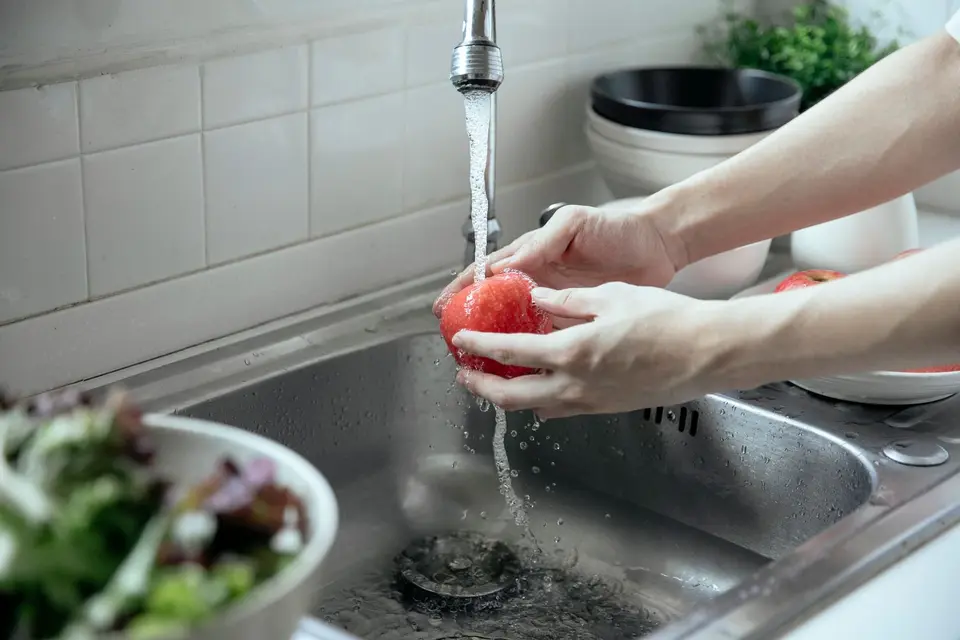
Wash fruit under running water before you cut it, even if you plan to peel it. The US Food and Drug Administration gives the reason: dirt and bacteria on the surface can be carried inward by the knife or the fingers. The shiny or waxy layer on some fruit is not a reason to avoid eating it, according to Thai FDA, but it is a reason to rinse well.
Wash first, then peel or cut
The US Food and Drug Administration says to wash all produce thoroughly under running water before preparing or eating it. It states that, even if you do not plan to eat the skin, washing first matters so that dirt and bacteria are not transferred from the surface when peeling or cutting. It does not recommend soap, detergent or commercial produce wash. For firm fruit such as melons, it advises scrubbing with a clean produce brush, and it recommends drying afterwards with a clean cloth or paper towel.
University of Maine Cooperative Extension makes one exception for soft fruit: berries should not be washed until they are ready to be eaten.
The US guidance names melons directly, and the same reasoning applies to any fruit with a skin or rind that a knife will pass through.
Natural bloom and wax coatings
Fruit makes its own wax-like layer, which reduces water loss. Thai FDA says this natural layer may not protect the fruit for long, so wax coatings are sometimes added. The coating is used to extend storage life, to make fruit look fresh and to protect it from scratches and bruises caused by knocks.
Thai FDA explains what coatings are made from. Some come from plants or animals, such as tree gum, beeswax and shellac. Others come from petroleum. The agency states that the substances used on fruit are food grade and safe to eat, and that only enough is used to form a thin film. As an example, it says one apple carries only one to two drops of wax.
The page was written to correct a viral post. In it, an apple was dipped in hot water and wax came off, and people concluded that unpeeled fruit was unsafe. Thai FDA called that claim untrue. It added that pesticide residues are a bigger concern than the coating, so fruit should be washed well before eating.
Thai FDA's three soaking methods, with running water, vinegar or baking soda, are presented for vegetables and fruit alike. The same Thai FDA page says that washing cannot remove residues completely, and it advises choosing produce with natural colour and no unusual smell.
What the Thai study found
The Department of Medical Sciences measured residues on oranges before and after treatment. It looked for 53 pesticide compounds. Washing with water lowered the residues by 14 to 96 percent, a wide range. Peeling lowered them by 100 percent. The study covered oranges, and it does not say the same numbers hold for other fruit.
Putting the two sources together gives a practical order: rinse first, so the knife does not carry surface material inward, and then peel if you like.
In short
- Wash fruit under running water before cutting, even if you will peel it, as the US Food and Drug Administration advises.
- Fruit makes a natural waxy layer, and added coatings are described by Thai FDA as food grade and used in very small amounts.
- In a Thai test on oranges, washing with water lowered pesticide residues by 14 to 96 percent and peeling by 100 percent.
- Berries stay unwashed until you are ready to eat them.
Sources
- Selecting and Serving Produce Safely, US Food and Drug Administration
- Claim that wax-coated fruit must not be eaten is not true (ผลไม้เคลือบแว็กซ์ ห้ามกิน ไม่จริง), Thai FDA, Check Sure Share, September 2020
- Ways to reduce pesticide residues in vegetables and fruit (วิธีลดปริมาณสารเคมีป้องกันกำจัดศัตรูพืชตกค้างในผักและผลไม้), Bulletin of the Department of Medical Sciences
- Three ways to wash vegetables (3 วิธีล้างผัก เพื่อลดสารเคมีตกค้าง), Thai FDA
- Storing Garden Produce, University of Maine Cooperative Extension