A rice name in Thailand can mean four different things. Thai Hom Mali is defined by an official standard. Riceberry is a named variety with a coloured bran. Sangyod is a variety tied to a place. Glutinous rice is a type defined by the starch in the grain. Knowing which kind of name you are reading helps you understand what it promises.
Thai Hom Mali rice, defined by a standard
Thailand has a voluntary standard for Thai Hom Mali rice, TAS 4000, issued by the National Bureau of Agricultural Commodity and Food Standards (ACFS). It covers rice from the commercial varieties that the Ministry of Agriculture and Cooperatives has announced as Khao Dok Mali 105 and RD15. The standard describes them as fragrant varieties that are sensitive to day length, grown in Thailand in the main crop season, with soft cooked rice.
The standard sets measurable limits. Some examples:
- the paddy husk is straw coloured
- after husking, whole kernels average at least 7.0 millimetres long, and the length is at least 3.2 times the width
- the polished rice has a natural fragrance
- the starch of white rice has 13.0 to 18.0 percent amylose, measured at 14 percent moisture
Amylose is a type of starch. The standard notes that higher amylose makes cooked rice firmer. The standard covers paddy, brown rice and white rice in packs.
Riceberry and other coloured rice
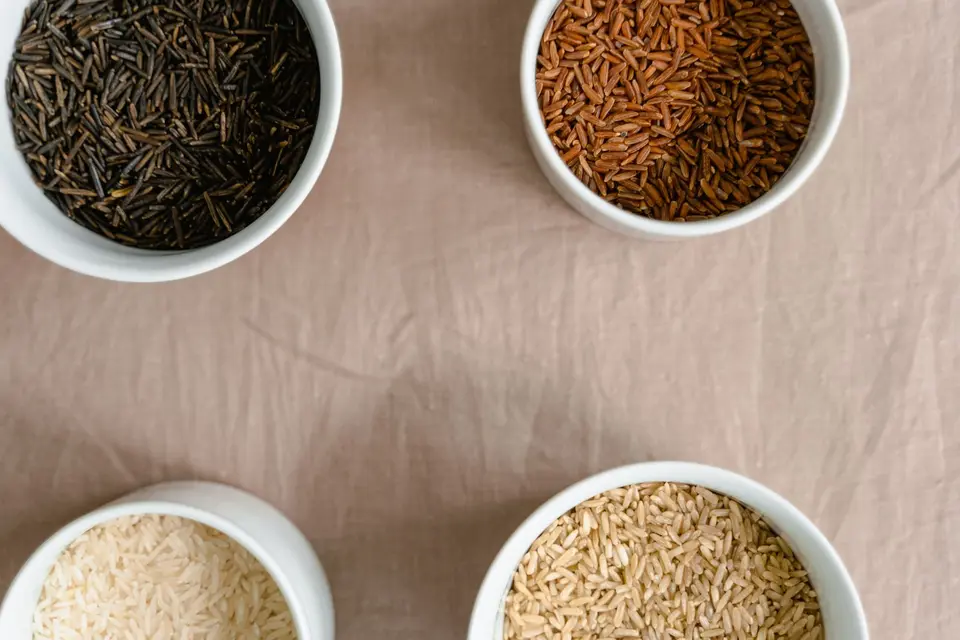
Thai Colour Rice, TAS 4006, covers rice whose bran layer has an inherited colour, such as red, brown, purple or dark purple. It applies to paddy, brown rice and partially milled rice. White polished rice is outside it.
Riceberry appears in the standard as an example of a non-glutinous variety with a purple to dark purple bran. The standard's table for it lists amylose at 14 to 18 percent, brown rice 6.3 to 7.7 millimetres long, and no sensitivity to day length. Other examples in the same table include Hom Nin, which has similar bran colour, and Sangyod Phatthalung, which has red bran.
Sangyod, a rice tied to a place
Sangyod rice is a variety, but "Sangyod Muang Phatthalung" is also a registered geographical indication, usually shortened to GI. A GI is a name that indicates the origin and quality of a product, tied to a place. Thailand protects GIs under its Geographical Indications Act of 2003.
A 2024 study in the journal Agriculture and Natural Resources lists the registered Thai GI rice products. For Sangyod Muang Phatthalung it describes a non-waxy rice from the Sang Yod variety, grown in the main season in Phatthalung province, with a small, slender grain and a red seed colour.
Hom Mali also has place-named GIs, and these are separate from the national standard. The study lists Hom Mali Thung Kula Rong-Hai, grown in five north-eastern provinces (Roi Et, Maha Sarakham, Surin, Yasothon and Si Sa Ket), as well as Hom Mali Surin and Hom Mali Phayao. The same varieties are behind each. The place name tells you where the rice was grown.
Glutinous rice, defined by starch
The Thai rice standard, TAS 4004, defines glutinous rice as a variety whose white grain is opaque throughout and which turns sticky and clumps together when steamed. Non-glutinous rice has a clear grain.
The same standard sorts rice by amylose, which explains how cooked grains behave:
- soft non-glutinous rice: 13.0 to 20.0 percent amylose, soft and slightly sticky when cooked
- medium non-glutinous rice: above 20.0 up to 25.0 percent, loose and fairly soft
- hard non-glutinous rice: above 25.0 percent, loose and firm
- glutinous rice: very little or no amylose, sticky when steamed
In short
- Thai Hom Mali is defined by the voluntary standard TAS 4000, which names Khao Dok Mali 105 and RD15 and sets limits such as 13.0 to 18.0 percent amylose.
- Riceberry is listed in the Thai colour rice standard as a purple-bran, non-glutinous variety.
- Sangyod Muang Phatthalung is a registered Thai GI for a red-grained rice grown in the main season in Phatthalung province.
- A GI name tells you about place. A standard tells you about measured quality. A variety name tells you about the plant.
- Glutinous rice is defined by its starch: very little or no amylose, so it turns sticky when steamed.
Sources
- Thai Agricultural Standard TAS 4000-2017, Thai Hom Mali Rice (ACFS)
- Thai Agricultural Standard TAS 4006-2017, Thai Colour Rice (ACFS)
- Thai Agricultural Standard TAS 4004-2017, Rice (ACFS)
- Glycemic responses of special rice, case study in Thai geographical indication rice cultivars (Agriculture and Natural Resources, 2024)