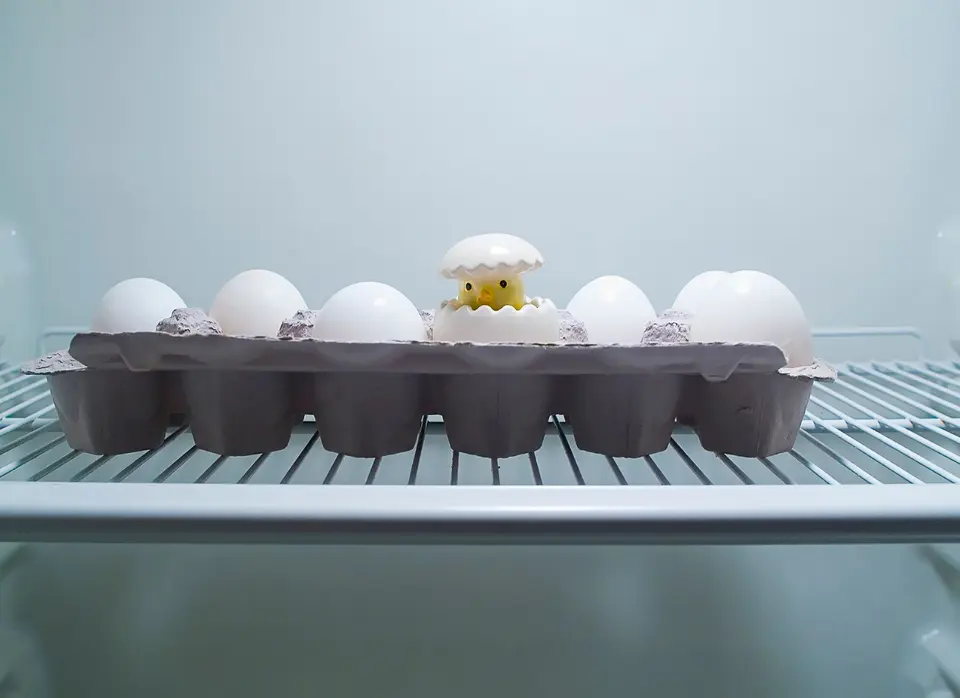
In Thailand, the guidance on eggs is to keep them at normal room temperature for up to about a week and then move them into the refrigerator. Eggs that are going to be kept longer are best in the cold. Keep them in their carton, and leave them unfrozen. How long they keep after that depends on which country's rules the eggs were handled under, which is why advice you read online often disagrees.
What Thailand says
The Thai egg standard, TAS 6702-2010, says that eggs stored for more than one week should be in a refrigerator or in a temperature-controlled room at 10 to 13 degrees Celsius with 70 to 80 percent relative humidity. It is a voluntary standard. It also says packed eggs should be stored in a clean, ventilated place free from foreign smells.
The Director-General of the Department of Livestock Development said in 2022 that eggs should be stored at about 4 degrees Celsius, in the egg compartment of the fridge. Eggs kept at normal temperature should go into the fridge after 7 days. The same statement advised against the freezer, because freezing changes the protein.
Some practical points follow from these two sources:
- Keep eggs in their carton, which also keeps the date and lot information with them.
- Choose a shelf inside the fridge instead of the door. Iowa State University Extension advises the inside shelf because the door's temperature swings more.
- Keep eggs away from strong smells, as the standard asks of storage areas.
Why other countries give other advice
Advice differs because eggs are treated differently on the way to you.
United States. According to the US Department of Agriculture, every US producer washes its eggs, and the practice began in the early 1970s. The US Food and Drug Administration requires eggs to be held at 45 degrees Fahrenheit, about 7 degrees Celsius, from 36 hours after laying. Washing and drying affect the shell's natural outer coating, called the cuticle or bloom, and US eggs are meant to be kept cold. Iowa State University Extension says eggs kept in the carton at or below about 4 degrees Celsius hold their quality for 3 to 5 weeks.
European Union. Class A eggs must not be washed or cleaned before or after grading, and they may not be chilled in packing premises below 5 degrees Celsius, except for short periods. The rules explain that washing can damage the shell's natural barrier. USDA researchers note that most EU countries neither wash nor refrigerate eggs, even in stores.
Thailand. The Thai standard does not mention washing. It asks for clean, unbroken shells and sets the one-week point for refrigeration.
What a storage study found
A US Department of Agriculture study followed 5,400 eggs for 15 weeks. Eggs kept in the refrigerator, whether washed or oiled, were still Grade A on average at the end. Unwashed eggs kept at room temperature, which was 22 degrees Celsius in that study, fell from Grade AA to Grade B within one week.
Once eggs have been in the cold, extension advice in the US is not to leave them out for more than 2 hours, because a cold egg left out can sweat, and moisture can help bacteria move into the egg.
In short
- In Thailand, move eggs to the fridge after about 7 days at normal temperature, and do not freeze them.
- The Thai standard sets 10 to 13 degrees Celsius with 70 to 80 percent humidity for storage beyond a week.
- Keep eggs in the carton on an inside shelf, not the door.
- US, EU and Thai handling differ on washing and chilling, so each country's advice fits its own system.
- Each rule in this article belongs to the country named beside it.
Sources
- Thai Agricultural Standard TAS 6702-2010, Hen Egg (unofficial English translation, ACFS)
- Public Relations Department, Livestock OK mark and choosing fresh eggs (statement by the Director-General of the Department of Livestock Development, 20 May 2022)
- Commission Delegated Regulation (EU) 2023/2465 on marketing standards for eggs
- USDA Agricultural Research Service, Tellus article on why eggs are stored as they are
- Iowa State University Extension and Outreach, Egg Safety Q&As