Organic farms in general feed the soil first and the plant second. They do this by returning plant and animal material to the land as compost, by growing cover crops that are turned back into the soil, and by changing what is grown in each field from one season to the next. The Thai organic standard, TAS 9000, asks for exactly this kind of soil care and does not allow synthetic fertilisers.
What the Thai standard requires
The crop section of TAS 9000 says that soil fertility should be fed mainly through the soil's own living system. For land crops it calls for a soil-based system, meaning living soil.
The standard lists the practices that maintain and raise fertility:
- legumes, cover crops and soil-building plants, used in rotation and as green manure, with jack bean and sunn hemp as examples
- organic material from crops or livestock that follow the standard
- manure and other organic matter that has been properly composted and comes from organic production, or that meets the standard's list of permitted inputs
- recycling organic material within the farm where possible, for example green manure and compost
The standard also lists what must not be used for fertility: synthetic fertilisers, fertilisers made soluble by chemical treatment such as superphosphate, and human waste on food crops. It defines crop rotation as alternating the species or families of annual and biennial crops on a given piece of land in a planned order, to break cycles of weeds, pests and disease and to maintain or improve soil fertility.
Soil also needs time. For annual crops the standard sets at least 12 months of organic management before planting, and for perennial crops at least 18 months before the first organic harvest.
Compost
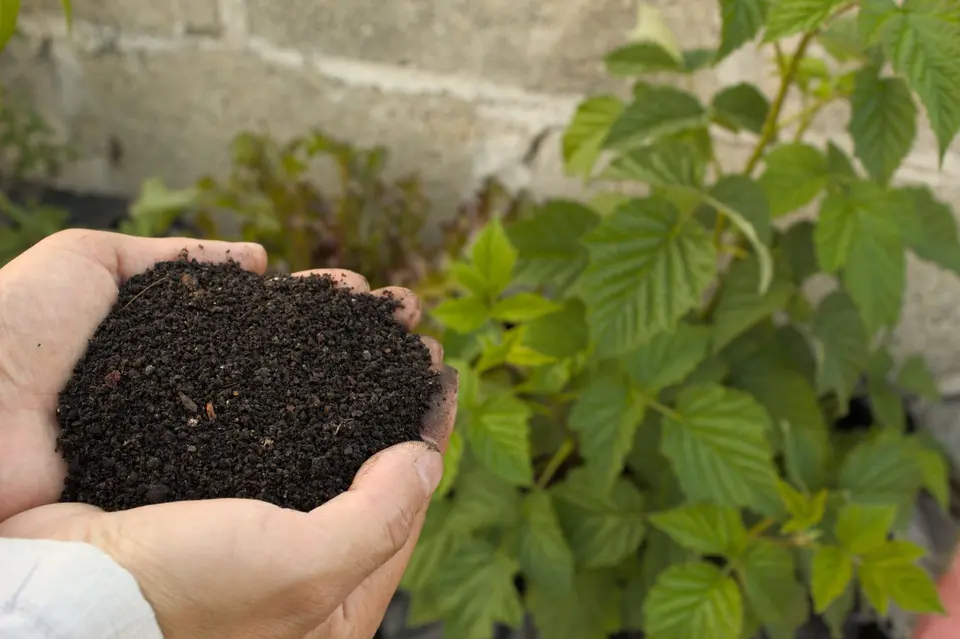
FAO describes compost as a soil-like material made from decomposed organic matter. Plants and other organic matter, such as animal manure, are put in a pile. Chopping the material speeds the breakdown. FAO says composting takes about three months, depending on conditions. Kitchen waste, plant residue and weeds can all go in, provided the weed seeds do not end up in the finished compost. The result is a dark, fine, humus-like material that is spread on the soil to improve it.
FAO's soil organic matter publication explains why this matters. It says organic matter improves the seedbed and increases the soil's capacity to take in and hold water. It also buffers pH and makes nutrients easier for plants to reach.
Green manure and rotation
FAO defines green manure and cover crops as plants grown to cover the soil and to improve its physical, chemical and biological qualities. Its list of aims includes protecting soil from erosion, reducing weeds, adding plant material that builds organic matter and feeds soil life, and improving soil structure.
Legumes have a special role. Bacteria in nodules on their roots fix nitrogen from the air, and later crops may use that nitrogen. FAO also notes that deep-rooted cover crops can recycle nutrients that had washed down to deeper layers.
Rotation does a different job. FAO defines it as alternating crops with different characteristics on the same field over successive years in a planned sequence. Growing the same species year after year in one place leads to more pests and diseases, certain weeds multiplying and lower yields, it says. It calls rotation the most efficient and economical way to break the biological cycles of pests and diseases.
In short
- Organic farming in general starts with soil: compost, green manure and rotation, rather than synthetic fertiliser.
- TAS 9000 prohibits synthetic fertilisers and asks that fertility be fed mainly through the soil's own life, with composted manure from approved sources.
- Compost is decomposed plant and animal matter, and FAO says it takes about three months to make.
- Legume cover crops add nitrogen, and rotation breaks pest and disease cycles.
- The standard requires at least 12 months of organic management before planting annual crops.
Sources
- Thai Agricultural Standard TAS 9000-2021, Organic Agriculture (มกษ. 9000-2564), National Bureau of Agricultural Commodity and Food Standards
- Compost, Home Garden Technology Leaflet 6, FAO
- Green manure/cover crops and crop rotation in Conservation Agriculture on small farms, FAO Integrated Crop Management Vol. 12
- The importance of soil organic matter, FAO