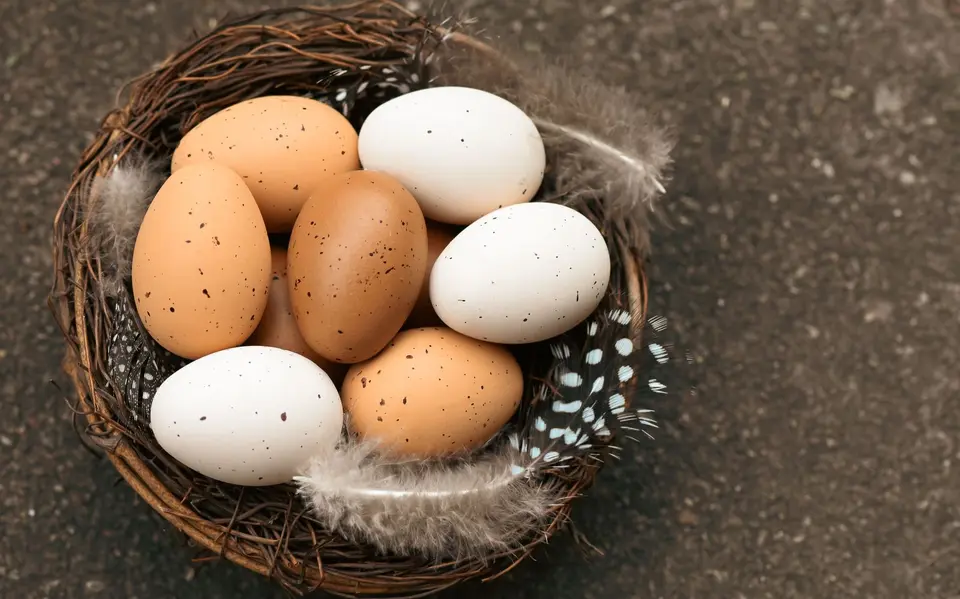
The colour of the shell is mainly set by the breed of the hen. The colour of the yolk is set by the pigments in her feed. Neither colour is part of the written definitions of how hens are housed, so neither can be read as a sign of how the hens were kept.
Shell colour comes from the breed
University of Florida extension explains that shell colour comes from pigments in the outer layer of the shell, and that it is primarily a characteristic of the breed. The commercial breeds lay white or brown eggs. In general, breeds with white earlobes lay white eggs, and breeds with red earlobes lay brown eggs. There can still be variation between individual hens of the same breed, so a single flock can lay a range of shades.
The same source notes that brown-egg breeds are slightly larger birds that eat more food, and that shell colour has nothing to do with egg quality, flavour or cooking characteristics.
The Thai egg standard, TAS 6702-2010, treats shell colour the same way. It asks only that the shell colour be "of the breed characteristic", clean and smooth. It does not rank one colour above another. Its grades are based on cleanliness, smoothness, air space and how the egg looks when broken out.
Yolk colour comes from feed pigments
University of Florida extension states that yolk colour depends on the diet of the hen. If she gets plenty of yellow-orange plant pigments called xanthophylls, they are deposited in the yolk. Utah State University extension names the main pigments as xanthophylls, lutein and zeaxanthin.
The source describes how this works in practice:
- Hens fed mash with yellow corn and alfalfa meal lay eggs with yellow yolks.
- Hens fed white corn, grain sorghum, wheat or barley lay eggs with lighter yolks.
- Natural yellow-orange material such as marigold petals may be added to feed to deepen the colour.
- Utah State University extension adds that synthetic pigments such as canthaxanthin can also deepen yolk colour.
So a deep orange yolk tells you that the feed carried a lot of pigment. It does not tell you where the pigment came from. It might come from the grain the hens ate, from plant material added to the feed, or from a synthetic pigment.
The University of Florida source also says that yolk colour preferences vary between countries. Some consumers like pale yolks and others prefer a darker orange, and in most cases the diet is altered to produce the yolk colour a particular market wants. The pigments are fairly stable and are not lost or changed in cooking.
The Thai standard asks only that the yolk have a normal and consistent colour.
Why colour is not a housing label
The farming-method rules look at conditions such as space, perches, nests, litter and outdoor access. The European Union's definitions of free range, barn and enriched cage eggs, and the Thai Department of Livestock Development's criteria for cage-free layer farms, are written in those terms. Neither document mentions shell colour or yolk colour as a requirement or as a test.
That is why shell colour is not a measure of quality, and a dark yolk is not evidence of a particular farming system. If you want to know how hens were kept, the evidence is a named standard on the carton and a body that inspects against it.
In short
- Breed is the main factor in shell colour, with white and brown being the common commercial colours.
- Yolk colour follows the pigments in the hen's feed, such as those from yellow corn, marigold petals or synthetic additions.
- The Thai egg standard calls for a shell colour typical of the breed and a normal, consistent yolk colour.
- Farming-method definitions in the EU and in Thai cage-free criteria do not use colour.
- To learn how hens were kept, look for a named standard, not for a shade.
Sources
- University of Florida IFAS Extension, PS24 Egg Quality
- Utah State University Extension, A Farmer's Guide to Egg Quality, Safety, and Flock Health
- Thai Agricultural Standard TAS 6702-2010, Hen Egg (unofficial English translation, ACFS)
- Commission Delegated Regulation (EU) 2023/2465 on marketing standards for eggs
- Department of Livestock Development, audit criteria for cage-free layer farms (effective 15 February 2021)