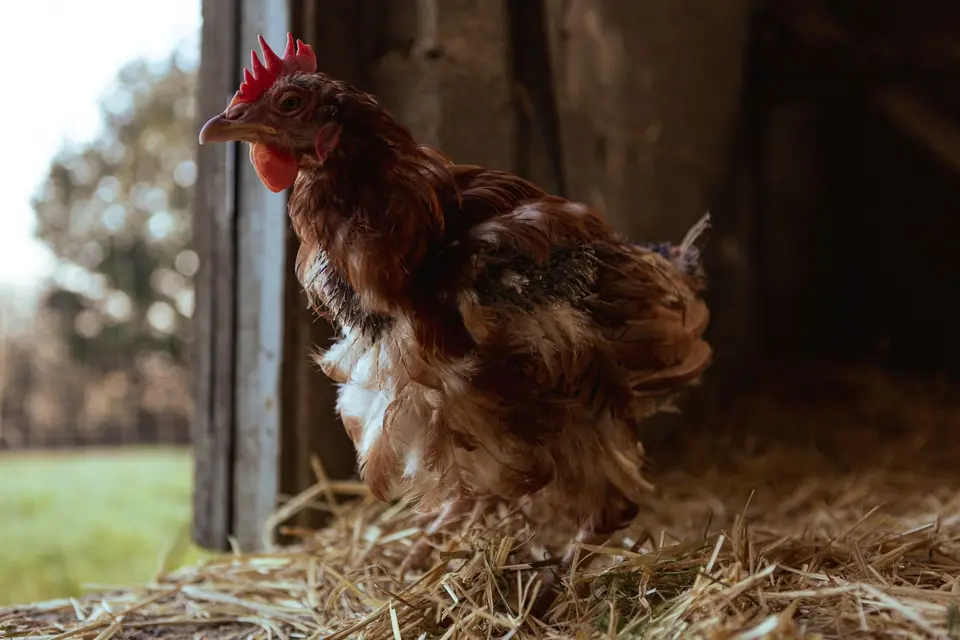
Cage, cage-free, free range and organic are labels for how laying hens are housed and managed. Each means something specific only where a written standard defines it. In Thailand, cage-free and organic have written rules for egg farms. The Thai free range standard covers native chickens raised for meat and leaves egg production out. This article describes each word as a definition and names the document behind it.
What Thai documents define
Cage-free. The Department of Livestock Development publishes audit criteria for cage-free layer farms, in use from 15 February 2021. The hens are kept loose in the house instead of in cages. The criteria set a ceiling of 9 laying hens per square metre, nests at a rate of one nest for every 7 hens, perches of at least 15 cm per hen, and no more than 4 levels of floor. The farm must also be certified for good agricultural practice in livestock. The criteria describe the house. They do not mention outdoor access.
Organic. The Thai organic livestock standard, TAS 9000 Part 2, says poultry must be reared free to move, with enough outdoor area to show natural behaviour. Its tables give no more than 5 laying hens per square metre indoors and 4 square metres of rotating outdoor area per laying hen. It also bans artificial light used to push up egg output.
Free range. Thailand has a free range standard, TAS 6914, but it covers native chickens raised for meat. Its guideline says plainly that it does not cover chickens kept for eggs. The Thai egg standard, TAS 6702, does not define free range or cage-free either.
Cage. The Thai documents above do not set out a specification for cage systems, so the next section uses the EU as the clearest public example.
The EU codes 0 to 3
In the European Union, the first digit printed on an egg is the farming method. The digit comes from Directive 2002/4/EC, and the method definitions come from EU egg rules.
- 0, organic. Eggs from organic production under EU organic law.
- 1, free range. Hens have continuous daytime access to open-air runs. The runs are mainly covered with vegetation. Stocking in the runs is at most 2,500 hens per hectare, which is one hen per 4 square metres, with limits on how far the run extends from the building.
- 2, barn. Hens are kept indoors on the floor system set out in Directive 1999/74/EC. Stocking is at most 9 laying hens per square metre of usable area, with nests, perches and a littered area.
- 3, cages. Since 1 January 2012 the older, plain cages have been prohibited. Eggs coded 3 come from enriched cages, which give at least 750 square centimetres per hen, a nest, litter and perches.
Packs of EU Class A eggs must show the farming method in words, and the meaning of the producer code must be explained on or inside the pack.
What a definition does not do
A definition is a list of conditions, and it covers only the topics it lists. A housing definition says nothing about feed, breed or the size of the farm. A cage-free house and an organic house are different documents with different checks.
The words also do not rank themselves. Each tells you which conditions a written standard sets and who is supposed to check them. Whether a particular carton meets one of these definitions depends on the carton's own evidence, such as a named standard and a body that inspects against it.
In short
- Cage-free has Thai audit criteria from the Department of Livestock Development, with up to 9 hens per square metre indoors.
- Organic has its own Thai livestock standard, with outdoor area and lower indoor stocking.
- Thailand's free range standard covers native chickens raised for meat, not eggs.
- In the EU, the first digit on an egg gives the method: 0 organic, 1 free range, 2 barn, 3 cages.
- A word on a label is only as clear as the standard and the checks behind it.
Sources
- Department of Livestock Development, audit criteria for cage-free layer farms (effective 15 February 2021)
- Department of Livestock Development, TAS 6914(G)-2017 guideline, good agricultural practice for free range native chicken farms
- Department of Livestock Development manual 2024, reproducing TAS 9000 Part 2-2018, Organic Livestock
- Commission Delegated Regulation (EU) 2023/2465 on marketing standards for eggs
- Council Directive 1999/74/EC laying down minimum standards for the protection of laying hens