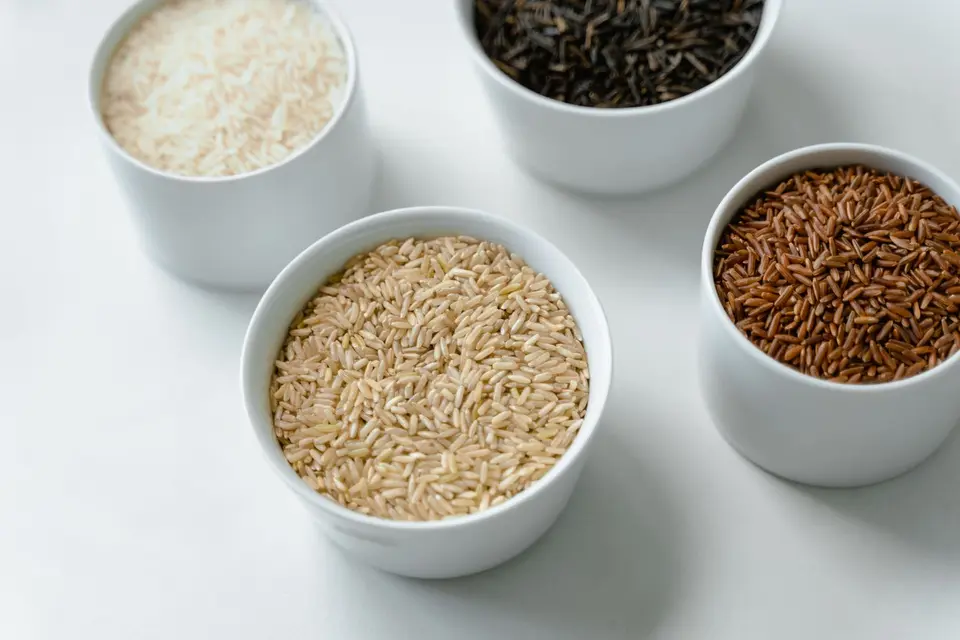
Brown rice and white rice are the same grain. Brown rice is rice with only the husk taken off. White rice is brown rice that has also been polished, which removes the bran. Germinated brown rice is brown rice that has been soaked until a tiny root shows, then dried or heated.
From paddy to white rice
Rice as it is harvested is called paddy. In the Thai rice standard, paddy is rice that has not yet had its husk removed. The husk is a tough outer shell. The Food and Agriculture Organization of the United Nations (FAO) says it makes up about 20 percent of the weight of rough rice, with values from 16 to 28 percent depending on the crop.
Take the husk off and you have brown rice. The Thai standard defines brown rice as rice that has been husked and nothing more. Inside, the grain has a few layers. FAO gives this split of brown rice weight:
- pericarp, the thin outer skin: 1 to 2 percent
- aleurone, nucellus and seed coat: 4 to 6 percent
- germ, the part that can sprout: 1 percent
- scutellum, a small tissue beside the germ: 2 percent
- endosperm, the starchy centre: 90 to 91 percent
People often use the word bran for the outer layers together. In milling, bran is the layer taken off during whitening. The Thai standard defines white rice as brown non-glutinous rice that has had its bran removed, and white glutinous rice in the same way. Rice with only part of the bran removed is called partially milled rice in a separate Thai standard for coloured rice.
Milling is a matter of degree. FAO describes under-milled rice as rice that still has its inner bran layers, and well-milled rice as rice with the germ and most of the bran taken off. So "white" covers a range, not a single product.
Parboiled rice is a different route. In the Thai standard it is rice that has gone through a parboiling process and then had its bran removed.
What germinated brown rice is
Thailand has a standard for germinated brown rice, TAS 4003, issued by the National Bureau of Agricultural Commodity and Food Standards (ACFS) as a voluntary standard. It defines the product as rice that has been soaked, as paddy or as brown rice, and kept in water until a root about 0.5 to 1 millimetre long appears. The sprouted grain is then treated with heat, such as steaming, baking or boiling, or dried to lower its moisture. If it starts as paddy, the husk is taken off after drying.
The standard sets some quality limits for packed germinated brown rice:
- whole kernels: at least 90 percent by weight
- moisture: no more than 14 percent by weight
- GABA: at least 5 milligrams per 100 grams of dry weight
GABA is short for gamma aminobutyric acid. The standard describes it as an amino acid that is not a protein, formed when rice germinates, and says the amount depends on the raw material and the process. The standard also says the pack must be clean, dry and sealed or vacuum packed, and that the label carries the net weight, the producer, a manufacturing date or a best-before date, and storage advice. The product name has to be one of the names the standard lists, such as germinated brown rice.
What this does not tell you
Comparing brown, white and germinated rice on nutrients is a different question. Results depend on the variety, the milling and the method, and this article does not rely on any such comparison. The structural facts above are the ones the sources agree on.
One practical point does follow from the layers. In the Thai rice standard, a pack of brown rice has to show a best-before date. That is a reminder that brown rice is stored differently from white rice, which is covered in the article on storing rice.
In short
- Paddy is rice in its husk. Brown rice is paddy with the husk removed. White rice is brown rice with the bran removed.
- By FAO figures, the husk is about 20 percent of paddy weight, and the starchy endosperm is 90 to 91 percent of brown rice.
- Milling is a range. Partially milled and under-milled rice keep part of the bran.
- Germinated brown rice is soaked until a root of about 0.5 to 1 millimetre appears, then heated or dried, as Thai standard TAS 4003 defines it.
- Brown rice labels in Thailand carry a best-before date.
Sources
- Rice in human nutrition, grain structure, composition and consumers' criteria for quality (FAO)
- Towards integrated commodity and pest management in grain storage, physical grain characteristics of paddy and milled rice (FAO)
- Thai Agricultural Standard TAS 4004-2017, Rice (ACFS)
- Thai Agricultural Standard TAS 4003-2012, Germinated Brown Rice (ACFS)